Reference
·For Creative agencies
Measuring Fleet Wrap Impressions: 4 Methodologies and What Each Misses
Four working methods for measuring vehicle wrap impressions, what each one gets right, and where each one falls down — for the analyst who has to defend the number.
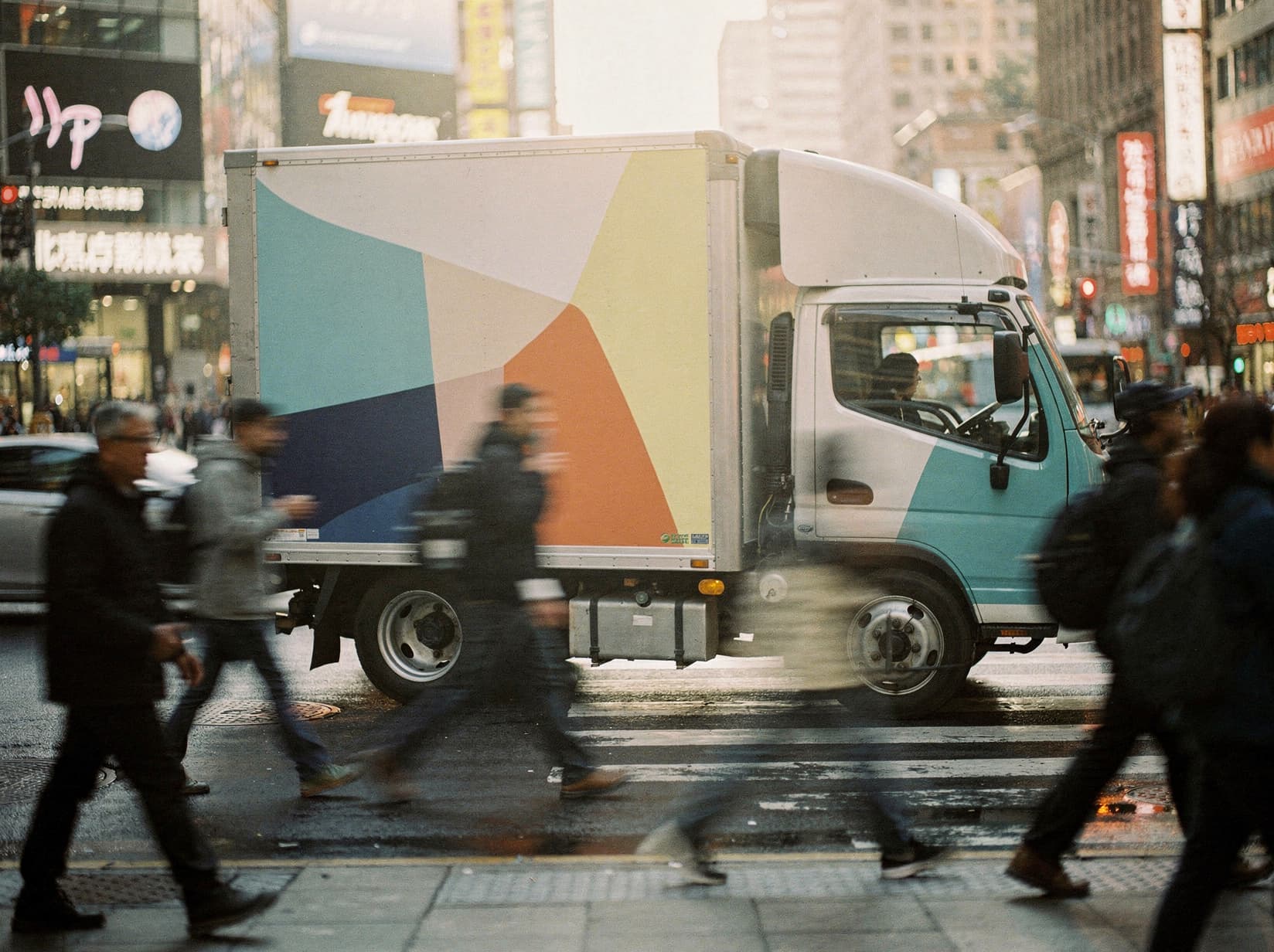
A client asks how many people will see their wrapped fleet. Whatever number you give, you'll have to defend. Wrap impressions are modeled, not measured, and the methodology you pick determines both how big the number looks and how confidently you can stand behind it.
This walks through the four methodologies in working use — what each does, what each misses, when to recommend each. For the agency analyst or in-house marketer who needs a credible number in a deck without leaning on the wrap shop's marketing copy.
Key takeaways
- 01There are four working methodologies for wrap impression measurement: miles times impressions-per-mile, GPS plus density data, survey-based recall studies, and social or earned-media tracking. Each measures a different thing, and combining methods is more honest than picking one.
- 02Miles times impressions-per-mile is the standard the industry uses. It's the cheapest and the easiest to defend, but it relies on third-party traffic-density assumptions that vary widely by source and route.
- 03GPS plus density data (the Geopath-style approach) is more accurate because it knows the actual route the vehicle drove and the actual traffic on that route. It costs more and most fleet operators don't have it instrumented.
- 04Survey-based recall is the gold standard for accuracy and the rarest in practice — it's expensive and only worth running on large campaigns where the cost of being wrong on attribution is higher than the cost of the survey.
Why this is harder than it looks
Out-of-home has had measurement methodology arguments for decades. OAAA and Geopath spent most of the 2010s rebuilding the industry standard from a circulation-based system to a panel-rated audience system. The billboard standard is reasonably mature; the fleet wrap standard lags behind it.
The reason is structural. A billboard is fixed; traffic past it can be measured directly. A fleet vehicle moves. Its route changes day to day, traffic density along the route varies by hour. Impression count is a function of the route actually driven, not a property of the vehicle.
Every wrap impression number is a model. The four methodologies below differ in how good their inputs are.
Methodology 1: Miles × impressions-per-mile
The standard the wrap industry uses for ROI calculators, sales decks, and most agency-facing impression estimates. It's also the methodology powering Surface's wrap ROI calculator.
The math: (Miles per year) × (Impressions per mile) = Annual impressions
Impressions-per-mile is a published assumption, ranging roughly 30 to 70+ depending on whether the vehicle operates in dense urban, suburban, or rural service areas. Outdoor advertising trade groups publish these multipliers based on historical traffic counts. Miles driven per year is usually known by the operator from fleet management software or odometer readings.
What it gets right
- Cheap and fast. Anyone with the operator's miles-per-year number can produce an impression estimate in under a minute.
- Defensible at the category level. The methodology is transparent and the inputs are publicly defensible. A client challenging the number is challenging an industry-standard assumption, not your math.
- Useful for planning. When the question is "should we do a fleet wrap at all?" the relative magnitude is correct even when the absolute number is approximate.
- Comparable across vehicles. All vehicles in the fleet measured the same way. Internal comparisons stay clean.
What it misses
- Route-specific traffic density. A van on suburban service routes generates different impression density than one on downtown delivery routes. The flat multiplier averages this away.
- Time-of-day exposure. 100 miles at 3 a.m. generates fewer impressions than 100 miles in rush-hour. Miles-based math doesn't distinguish.
- Vehicle visibility differences. A wrapped Sprinter in standing traffic is more visible than a wrapped sedan at speed. The standard multipliers don't capture this fully.
- Parked-time impressions. A van parked at a job site for two hours generates real exposure that miles-based math counts as zero.
For most agency-side wrap planning conversations, this is where you start.
Methodology 2: GPS + density data (Geopath-style)
The next step up in accuracy uses GPS data from the vehicle and traffic-density data along the actual routes driven. Geopath, the joint industry committee that measures audiences for OOH media, uses a methodology along these lines for fixed billboards and is increasingly applied to mobile media.
The math is more involved:
Sum across all route segments × (segment-specific traffic density) × (vehicle visibility factor) = Annual impressions
The inputs are: GPS logs from the vehicle, traffic density data for every road segment driven (typically licensed from a traffic-data vendor), and a visibility factor that accounts for vehicle type, time of day, weather, and other modifiers.
What it gets right
- Route-specific accuracy. A vehicle that drove a known route past known traffic gets credit for the impressions that route generated, not an averaged estimate.
- Time-of-day weighting. Rush-hour miles count more than midnight miles. Matches reality.
- Comparable to billboard methodology. Lets clients put fleet wraps and billboards in the same media plan with consistent measurement.
- Defensible against scrutiny. When finance asks "how do you know?" the GPS log and traffic data are real, not assumed.
What it misses
- Cost and instrumentation. GPS tracking is standard on most fleet management, but integration with traffic-density data is custom work. Most operators aren't running it.
- Parked-time still hard. Methodology focuses on miles driven. A van parked for two hours still doesn't count cleanly.
- Doesn't measure recall. A vehicle passing within line of sight of 100,000 cars doesn't mean 100,000 people remembered the brand.
- Operational complexity. Adds work that small fleet operators won't take on for marketing's benefit alone.
GPS-plus-density is the right answer for large fleet operators with the budget to instrument the measurement, or for agencies running wrap programs at scale.
Methodology 3: Survey-based recall studies
The gold standard for impression measurement, and the rarest in practice. A survey-based recall study uses field research to ask people in a relevant geography whether they recall seeing the wrap and what they remember about it.
The math is fundamentally different — it doesn't try to estimate exposures at all. Instead, it estimates effective reach (the percentage of a target audience who recall the brand) and uses that to back into a relative comparison against other campaigns.
What it gets right
- Measures what actually matters. The point of marketing is recall and behavior change, not eyeball exposure. Surveys measure the outcome, not the input.
- Comparable to other media. Brand-lift studies run for digital, TV, print, and OOH using similar methodology. Cross-channel comparison becomes possible.
- Captures qualitative effects. Surveys can ask about brand sentiment, message recall, intent — things miles-driven and GPS models can't see.
- Most defensible to senior stakeholders. A CMO prefers "23% of our target audience recalled the brand" to "the wrap generated 2.3 million estimated impressions."
What it misses
- Cost. Real recall studies start at five figures. Rarely commissioned for sub-six-figure campaigns.
- Time. Designing, fielding, and analyzing takes weeks. Not useful for ongoing tactical optimization.
- Sample-size limits. Isolating wrap-attributable lift from other concurrent marketing is harder than it sounds.
- Recall doesn't equal action. Even strong recall doesn't tie directly to revenue.
When to recommend: large brand campaigns with budget for five-figure measurement spend, in a window where the wrap is the primary marketing activity in the target geography.
Methodology 4: Social and earned-media tracking
The newest methodology, and the one most aligned with how brands actually experience wrap visibility in 2026. A meaningful portion of wrap impressions today result in someone photographing the vehicle and posting it — to Instagram, TikTok, X, or wherever the audience lives. Tracking that secondary surface is a real data source.
The math is observational rather than modeled:
- Count brand mentions on social platforms in the campaign window
- Count tagged photos of branded vehicles
- Count UGC (user-generated content) featuring the wrap
- Estimate reach of those posts using platform-published reach data
What it gets right
- Real, observed exposures. Unlike modeled impressions, social mentions are events that actually happened.
- Earned-media value. A photographed wrap on a creator's feed with 200K followers is real, attributable visibility that can exceed a year of vehicle-driven impressions.
- Engagement, not just exposure. Likes, shares, and comments signal that the content resonated.
- Cheap to instrument. Brand-listening tools (Brandwatch, Sprout Social, Mention) can be configured with modest setup effort.
What it misses
- Long tail only. Most wrap exposures don't result in a photo. Social tracking measures the most engaged 1%, not all of them.
- Confounded with other marketing. Brand mentions in a campaign window include responses to digital ads, store visits, and word-of-mouth.
- Skews toward photogenic wraps. Creative wraps that demand photographing are over-represented.
- Platform measurement limits. Reach data is increasingly controlled by the platforms.
Social tracking works best as a complement, not a replacement: "We estimate X impressions via the modeled methodology, and we observed Y social mentions as direct evidence the wrap is generating brand attention."
The four methodologies side by side
What to recommend in practice
For most agency-side wrap programs, the working answer is layered.
Default measurement: Miles × impressions-per-mile, used for the headline number in the deck and the ROI calculator. This is what the client expects and what compares cleanly to other agencies' quotes.
Validation layer when budget allows: GPS-plus-density to confirm the modeled number isn't wildly off for the actual routes driven. Recommend for fleet programs over 10 vehicles, or where measurement quality is part of the agency pitch.
Brand-lift survey for the strategic argument: For large campaigns and multi-year commitments where the client wants to know "did this work?" Run once at baseline, once after 12 months.
Social tracking always: Set up brand listening from install day. The cost is trivial and the qualitative evidence of cultural traction supports the harder-to-prove brand claims.
The honest framing: no single methodology is complete. Combine methods, be transparent about which number comes from which source, avoid claiming any of them are precise truth.
What not to do
- Don't quote a single big impression number without methodology. "Your wrap will generate 2.5 million impressions" gets challenged in finance review and falls apart. Always include methodology in the same sentence.
- Don't mix methodologies in the same number. If miles-based math says 2 million and GPS-based says 1.4 million, don't average. Pick one for the headline, use the other as a cross-check.
- Don't promise attribution to revenue. Wrap impressions are a brand-investment metric, not direct-response. Promising revenue attribution sets the campaign up to fail.
- Don't treat the wrap shop's marketing copy as data. "Vehicle wraps generate up to 70,000 impressions per day" appears in nearly every wrap-shop pitch. It's defensible at the category level but isn't specific to your campaign.
If you're building OOH plans that include fleet wraps and you want a measurement framework that holds up to scrutiny, Surface for creative agencies → ships with a wrap ROI calculator that uses the miles-times-multiplier methodology cleanly, with the assumptions visible to the client. Pair it with the fleet wraps vs billboards comparison when the client asks how the formats stack up against each other on impression economics.
Related on Surface
Try Surface for free
The design tool built for vehicles, billboards, and every surface in between.
Keep reading
More from the blog
Workflow
The Pitch-Deck Wrap Mockup Workflow That Wins Client Approvals
How creative agencies present wrap concepts that survive the room — the pitch-deck workflow, the right mockups, and a revision strategy that wins approval.
Read
Comparison
Fleet Wraps vs. Billboards: Which Earns More Attention Per Dollar?
An honest, category-by-category comparison of fleet wraps and billboards — where each wins on cost-per-impression, reach, attribution, and what to recommend when a client asks.
Read
Reference
Vehicle Wrap Maintenance: How to Wash, Wax, and Make a Wrap Last 7 Years
A working maintenance guide for vehicle wraps — what to wash with, what to avoid, how to handle damage, and the routines that turn a 3-year wrap into a 7-year one.
Read