Reference
·For Industry
Vehicle Wrap Maintenance: How to Wash, Wax, and Make a Wrap Last 7 Years
A working maintenance guide for vehicle wraps — what to wash with, what to avoid, how to handle damage, and the routines that turn a 3-year wrap into a 7-year one.
A cast-vinyl wrap with proper care will hit the manufacturer's seven-year warranty. The same wrap with the wrong washing routine starts hazing at year two and lifts at the edges by year three. The difference is roughly fifteen minutes a week and knowing which products to keep away from the panels.
This is the working maintenance guide for vehicle wraps. It covers washing technique, products to use and avoid, how to handle the most common types of damage, and what removal looks like when the wrap reaches end of life. It's written for wrap owners — fleet managers, business owners, or anyone whose vehicle is wrapped — not for installers. The goal is the longest practical lifespan from the wrap you already paid for.
Key takeaways
- 01Always hand wash. Automatic car washes with brushes destroy wraps. Touchless automatic washes are mostly fine after the first 30 days but have their own risks (pressure too high, chemical residue).
- 02Use pH-neutral car wash soap and a microfiber wash mitt. Avoid degreasers, fuel-based cleaners, and any abrasive wash media. The wrong soap is the second-most-common cause of premature wrap failure after install errors.
- 03Wax and sealant are optional but extend life. Use only vinyl-safe products — 3M Wrap Care, Meguiar's Synthetic X-Press, dedicated wrap detail sprays. Carnauba wax made for paint is not vinyl-safe.
- 04Treat fuel splashes, bird droppings, and tree sap as urgent. Solvents in fuel will discolor the vinyl within hours. Bird droppings are acidic and etch into the laminate. Tree sap hardens and pulls off the surface when removed mechanically. Wipe immediately with the right cleaner.
Why maintenance matters more than you'd think
A wrap is a layered system: printed vinyl, laminate over the print, adhesive bonding it to the vehicle. All three layers degrade. Sun, road grime, fuel, salt, bird droppings, automatic car wash brushes, and aggressive chemicals all accelerate degradation.
Manufacturer warranties (3M's MCS, Avery's ICS) assume reasonable care. They explicitly exclude damage from misuse, including incompatible cleaners and mechanical abrasion from automatic car washes.[3M MCS] A wrap that fails at year three because it went through a brushed wash 80 times isn't a warranty claim — it's a maintenance failure.
The flip side: a wrap washed by hand with the right soap, kept out of brush washes, dried with microfiber will hold color and edge integrity through the full warranty period.
How to wash a wrap
The basic routine takes about 20 minutes per vehicle. Done every other week, it's the single most valuable maintenance habit.
The right tools
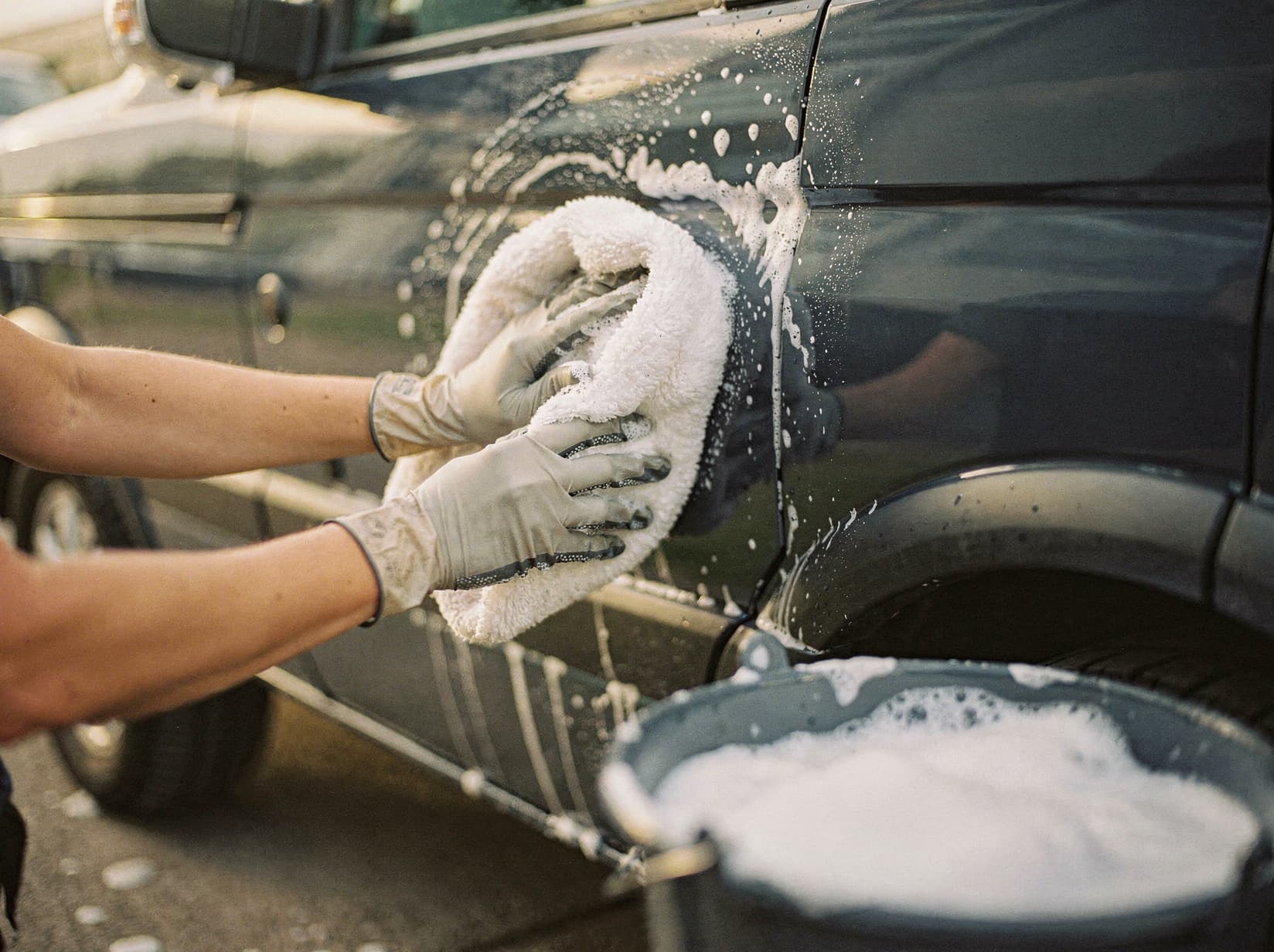
A clean bucket of cool to lukewarm water (hot water can soften adhesive). A pH-neutral car wash soap — wrap-specific products are best, but most premium pH-neutral car soaps marketed for paint are also wrap-safe. A microfiber wash mitt. A separate microfiber for drying (never reused as a wash mitt). A garden hose for rinsing.
The technique
Pre-rinse the entire vehicle with low-pressure water to remove grit before any contact with the wash mitt. Wash one panel at a time, top to bottom. Use light pressure — the wrap doesn't need to be scrubbed, it needs to be wiped. Rinse the mitt frequently in the bucket. Rinse each panel before moving on so soap doesn't dry. Dry with a clean microfiber, blotting rather than rubbing.
There's no advanced technique. Wraps fail from washing because of wrong products and wrong frequency (too rare lets contaminants etch; too aggressive scratches the laminate).
Pressure washer rules
Pressure washers work on wraps with restrictions: pressure under 1,500 PSI, nozzle at 40-degree fan or wider, distance of 12+ inches, never aimed directly at panel edges or seams. The simpler answer is to use a garden hose — well within the safe zone and gets the job done.
Heads up
Automatic brushed car washes destroy wraps. Brushes physically abrade the laminate, scratch the print, and lift edges over time. A wrap through a brushed wash twice a month for a year will look noticeably degraded. Avoid them entirely. Touchless automatic washes (water and chemical only, no brushes) are acceptable after the first 30 days post-install, but some use chemicals that aren't wrap-safe.
Products to use and products to avoid
Most maintenance failures come down to the wrong product. The compatible list is narrow.
Use these
- For washing: 3M Wrap Care Wash, Meguiar's wrap-specific soaps, or pH-neutral premium car wash soaps (Adam's Polishes Car Shampoo, Chemical Guys Mr. Pink, Meguiar's Gold Class).
- For wax / sealant: 3M Wrap Detailer for spray-and-wipe between washes,[3M Wrap Detailer] Meguiar's Synthetic X-Press Spray Wax (vinyl-safe per product label), dedicated vinyl wrap sealants from Chemical Guys or Adam's, and ceramic coatings rated for vinyl.
- For spot cleanup: isopropyl alcohol (70%) diluted further with water for sticker adhesive, used sparingly. Approved wrap-safe bug and tar removers (wrap-specific only, not paint formulations).
Avoid these
- Soaps: dish soap (alkaline, degrades laminate), degreaser-based washes, fuel-based cleaners (diesel, gasoline, kerosene), citrus or solvent-based cleaners.
- Wax and polish: carnauba waxes (formulated for paint, can haze matte/satin finishes), any polish or compound containing abrasives (wraps cannot be polished), tire shine sprays near the wrap.
- Tools: brushes of any kind, Magic Eraser / melamine foam (immediately damaging), terry cloth towels (too coarse), squeegees on the wrap surface.
If a product wasn't specifically tested for vinyl wrap compatibility, assume it isn't safe.
Wax, sealant, and ceramic coating
Optional but worth considering for any wrap meant to last 5+ years. A wax or sealant adds a sacrificial layer over the laminate that takes the abrasion and chemical contact instead of the laminate itself. Spray sealant lasts 1 to 3 months. Liquid sealant lasts 3 to 6. Ceramic coating lasts 12+ months but usually wants professional application.
For matte or satin finishes, be careful: glossing products change the apparent finish. A gloss-enhancer applied to a matte wrap turns it streaky satin and can't be reversed without removing the laminate. Use only products labeled for the specific finish you have.
Common damage and how to handle it
Most wrap damage comes from a small number of recurring incidents. Fast response keeps damage from becoming permanent.
Fuel splash. Gasoline and diesel are aggressive solvents on vinyl — they soften the laminate, can lift the print, and discolor within hours if left in place. Wipe immediately with a clean microfiber and water (no cleaning product first). Wash the panel with wrap soap within a day. Many wrap shops offer a clear protective film over the gas-cap area at install ($30 to $80 upcharge) — worth it on a vehicle fueled frequently.
Bird droppings. Acidic and etch into both paint and vinyl. The longer they sit (especially in sun), the deeper the etching. Soak with water for a minute to soften, then wipe with a microfiber and a touch of wrap-safe soap. Don't scrape — dried droppings have grit that scratches the laminate.
Tree sap. Hardens onto the laminate and resists removal. Use an approved wrap-safe bug and tar remover applied to a microfiber, held against the sap for a minute to soften, then wipe gently. For very hardened sap, diluted isopropyl alcohol can help; test in a small area first. Don't scrape with fingernails or hard tools.
Road tar. A wrap-safe bug and tar remover or diluted isopropyl alcohol, applied with a microfiber. For stubborn tar, apply, wait 1 to 2 minutes, wipe. Avoid commercial tar removers designed for paint — too aggressive for vinyl.
Salt (winter). Wash every 7 to 10 days instead of every two weeks. Pay attention to panel edges and door gaps where salt-laden water wicks under the film. Pre-rinse before contact with the wash mitt to flush abrasive crystals.
Scratches. Light scratches in the laminate sometimes buff out with very fine vinyl-specific polish. Deeper scratches reaching the print layer aren't repairable — they need a panel patch. Don't try to polish out scratches without confirming the product is wrap-safe.
Heads up
Don't use household cleaners on a wrap. Window cleaner with ammonia, all-purpose cleaners, dish soap, and anything with bleach or strong solvents will damage vinyl. The bottle in your kitchen is for your kitchen.
Storage and parking
Indoor or covered parking is ideal — shields the wrap from UV, weather, bird droppings, and tree debris. Avoid parking under trees (droppings and sap are the two most common environmental damage sources). Avoid prolonged direct sun when possible — UV is the slow killer. In hot climates, surface temperatures of 140°F+ are common on summer days; the film handles it, but it's why the cool-water washing rule exists (cold water on a hot panel stresses the adhesive).
When to expect what
A reasonably maintained wrap on an outdoor vehicle:
- Year 1: Looks essentially new.
- Year 2 to 3: Minor aging visible to a trained eye — slight gloss reduction on sun-exposed areas. Casual observers still see new.
- Year 4 to 5: Visible aging on horizontal surfaces (hood, roof). Vertical surfaces hold up. Color may fade 5 to 15% on most exposed panels.
- Year 6 to 7: End of warranty. Vertical surfaces still functional but visibly aged. Time to plan replacement.
- Year 8+: Out of warranty. Some wraps continue to look acceptable; others have failed. Removal gets harder as adhesive ages.
Indoor parking can extend these timelines 1 to 2 years. Hot sunny climates (Phoenix, Las Vegas, parts of Texas and Florida) compress them by the same.
Removal at end of life
Eventually the wrap comes off. The process matters because the underlying paint matters — especially on leased vehicles where condition affects return value.
Professional removal involves heat application (heat gun or steamer), slow peeling at a low angle, adhesive remover for residue, and final cleaning with a wrap-safe degreaser. Time is typically 1 to 4 hours per vehicle, depending on wrap age (older is harder), sun exposure, adhesive type (removable comes off cleaner), and underlying paint condition.
The clear-coat lift risk is the biggest practical consideration. On healthy modern factory paint (5 years old or less), removal almost never damages it. On aged paint, oxidized clear coat, or repainted panels with poor adhesion, removal can lift paint with the wrap. Not the wrap's fault — the paint was already failing — but it shows up at the same time and the wrap gets blamed. For vehicles where paint condition is uncertain, ask for a small test patch first.
DIY removal is possible but rarely worth it. Without a heat gun, the right adhesive remover, and the technique, the result is torn film, residual adhesive, and possible paint damage. A shop charges $300 to $800 for full removal — meaningfully cheaper than fixing a botched DIY job.
What to budget for maintenance
Annual costs for a properly cared-for single vehicle: under $50 for wash supplies, $30 to $150 for wax/sealant, $150 to $400 per visit for an optional professional detail (1 to 2 times per year), and variable spot-repair costs ($200 to $600 per panel patch). Total realistic ongoing maintenance is $200 to $800 per year — modest relative to a $4,000 to $8,000 wrap meant to last 5 to 7 years. For fleets, the per-vehicle math compounds but stays favorable.
A wrap that lasts the full warranty period is mostly the result of two upstream decisions and one ongoing habit: the right material spec at install time, the right install execution, and consistent hand-washing with the right products. For more on the material spec side, see our vehicle wrap material guide. The wrap you pay for is the wrap you keep — taking care of it is how the investment pays back.
Related on Surface
Try Surface for free
The design tool built for vehicles, billboards, and every surface in between.
Keep reading
More from the blog
Reference
Vehicle Wrap Design Trends That Actually Matter (and the Ones That Don't)
Strategic POV on vehicle wrap design trends — the ones that drive results, the ones that look great on Instagram and fail at 30 mph, and what stays constant.
Read
Reference
The Complete Vehicle Wrap Glossary: 40+ Terms Designers and Buyers Should Know
An A-Z glossary of vehicle wrap terms — from cast vinyl to weeding to MCS warranties. The vocabulary buyers and designers need to spec wraps without getting lost in jargon.
Read
Reference
Vehicle Wrap Material Guide: Cast vs. Calendared, Gloss vs. Matte, and When Each Wins
A practical guide to vehicle wrap vinyl, laminates, and adhesives — how to pick the right material for the job and stop losing money to delamination, lifting, and short lifespans.
Read