Reference
·For Industry
Vehicle Wrap Material Guide: Cast vs. Calendared, Gloss vs. Matte, and When Each Wins
A practical guide to vehicle wrap vinyl, laminates, and adhesives — how to pick the right material for the job and stop losing money to delamination, lifting, and short lifespans.
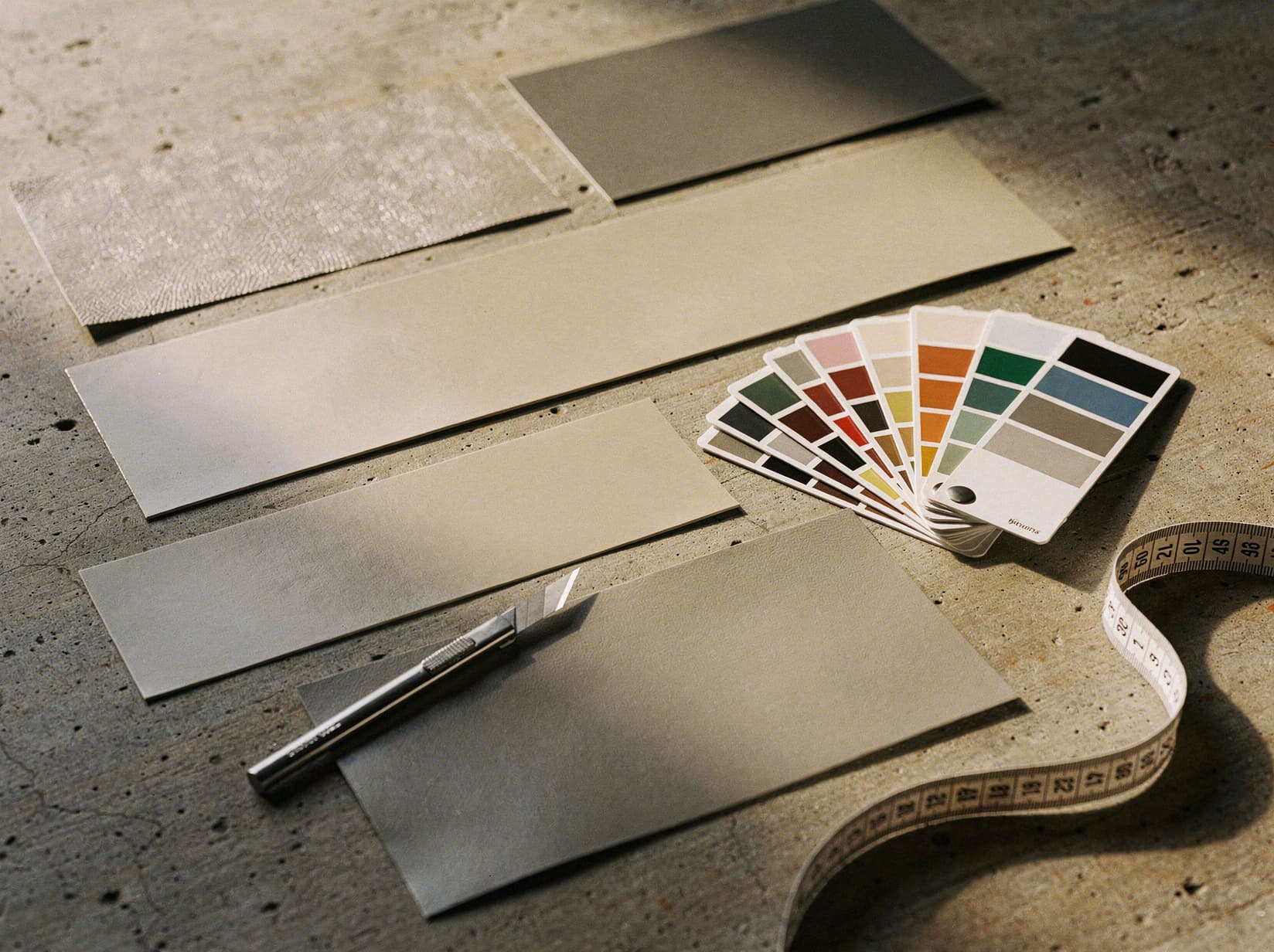
The wrong material wastes the install. A perfect design printed on the wrong film lifts off the bumper in a week, hazes in the sun, or won't conform to the curve over the wheel arch. The right material outlasts the vehicle's resale value.
This guide covers the four decisions that determine whether a wrap looks new at year five or peels at month six: vinyl construction, conformability, laminate, and adhesive. It's written for the people who specify, design, and install — wrap shops, print vendors, and in-house brand teams who want to stop relying on whatever the rep recommends.
Key takeaways
- 01Use cast vinyl for full vehicle wraps and anything with compound curves. Use calendared only for flat panels, short-term campaigns, or budget partials.
- 02Always laminate. Unlaminated wrap film hazes in months and fails MCS warranties. Pick gloss for impact, satin for forgiveness, matte for premium.
- 03Adhesive choice is about removal, not stickiness. Permanent adhesives are cheaper to apply; removable adhesives save you on the back end if the vehicle is leased or branded for a campaign.
- 04Specify everything on the PO: vinyl SKU, laminate SKU, ink set, expected install surface temperature, and target removal date. 'Generic wrap film' is how shops eat reprints.
The two vinyl categories that matter
Vehicle wrap vinyl comes in two manufacturing methods: cast and calendared. Everything else is a marketing variant on those two. The difference comes down to how the film is made.
Cast vinyl is poured as a liquid onto a casting sheet, then cured. The polymer chains relax during curing, which means the finished film has very little "memory" — it doesn't want to go back to a previous shape. That makes cast vinyl conformable, dimensionally stable over time, and resistant to shrinkage when it's stretched over a curve and heated.
Calendared vinyl is extruded and rolled flat between heated drums (calenders). The polymer chains are physically stretched and locked in that orientation. The film "remembers" its flat shape, so when you stretch it over a curve, it tries to relax back. Heat speeds this up: a calendared wrap on a hot panel can shrink and lift at the edges within a season.
The price difference is meaningful — cast films run roughly 2× the per-square-foot cost of calendared — but the difference in install time, reprint rate, and warrantied lifespan usually inverts the math by the time you're done.
When cast wins (almost always)
Pick cast vinyl for any of these:
- Full vehicle wraps. The film is going over compound curves (the C-pillar, the front bumper, the wheel arches). Calendared film will lift on the recovery curves within 6–18 months.
- Long-term branding. If the wrap is meant to live on the vehicle for 5+ years — a service van, a food truck, a fleet — the durability and color stability of cast film is what you're paying for.
- Anything that has to pass an MCS warranty. 3M's Matched Component System[3M MCS] and Avery's ICS Performance Guarantee[Avery ICS] both require specific cast vinyl + laminate + ink combinations. Substitute one component and the warranty is void.
- Dark colors over light vehicles (or vice versa). Cast films have better opacity at the same thickness, so you don't see "ghosting" of the underlying vehicle paint through the wrap.
The two cast films you'll see most often:
- 3M Wrap Film Series IJ180mc-114 — the industry workhorse. 7-year warranty on vertical surfaces, 3 years on horizontal.[3M IJ180mc datasheet]
- Avery Dennison MPI 1105 SuperCast — comparable warranty, slightly different conformability profile, often preferred for very tight curves.[Avery MPI 1105]
Oracal's premium cast line is 3951RA / 3955RA — slightly cheaper than 3M and Avery, common in shops with European supply.
When calendared wins (sometimes)
Calendared isn't always wrong. It wins when:
- The substrate is flat. Box truck side panels, trailer sides, and most billboard vinyl are flat surfaces where calendared film can sit happily for years.
- The campaign is short-term. Election cycles, race-weekend liveries, pop-up retail wraps. If the design is coming off in 6 months, you don't need cast-film durability and you shouldn't pay for it.
- You're doing partials, decals, or simple graphics. Door logos, fleet numbers, contact info bands — calendared cuts cleanly and applies easily, and the geometry doesn't punish it.
- Budget is the gating constraint. A non-profit's first fleet wrap or a startup food truck's launch livery often gets calendared because the cash flow doesn't support cast. That's a reasonable trade — just set the expectation that the wrap will need refresh in 2–3 years instead of 5+.
Common calendared options:
- 3M IJ35 — fleet-grade calendared, 5-year warranty on simple curves.[3M IJ35]
- Avery MPI 1005 — Avery's calendared workhorse.
- Oracal 651 / 751 — the standard for cut vinyl decals (not full wraps).
Conformability: the curve test
Manufacturer datasheets give you a "conformability" rating, but the practical test is simpler: hold the unrolled film over the most aggressive curve on the vehicle (usually a wheel arch or the curve of a hood scoop). Apply moderate hand tension. If the film wants to spring back flat, it will lift off the vehicle within months. If it stretches and stays where you put it, the install will hold.
Cast films pass this test by design. High-end calendared films (the "premium calendared" category — 3M IJ35-10, Avery MPI 1005 EZ) are getting closer, but they still have memory. The shop test before a job worth more than the cost of a roll of cast film: roll out 12 inches, stretch it over the curve, leave it for 5 minutes, see what happens.
Heads up
Recovery zones are where calendared fails. A "recovery curve" is the part of a panel where the film transitions from one plane to another — the inside of a wheel arch, the curve where a fender meets a bumper. Even calendared films that "stretch fine" in flat tests fail at the recovery zone within a season.
Laminate: the part that protects everything
Laminate is the clear protective film that goes over the printed vinyl. It does three things: (1) protects the print from UV, abrasion, and fuel/solvent contact, (2) determines the finish (gloss, satin, matte), and (3) is required by every manufacturer warranty.
Skipping the laminate to save money is the most common false economy in wrap installs. Unlaminated digital prints fade in months, especially with eco-solvent ink in direct sun. Laminated prints, with the right film, can hold color for 5–7 years.
Finish: gloss, satin, or matte
| Finish | When to specify | Trade-offs |
|---|---|---|
| Gloss | Maximum visual punch. Saturated colors. Brands that want to look new. Race liveries. | Shows every install bubble. Shows scratches. Reads "fleet" not "premium." |
| Satin | Good middle ground. Hides minor imperfections. Forgiving for installers. | Slight haze on dark colors. Less photogenic for marketing shots. |
| Matte | Premium aesthetic. Stealth wraps. Tactical/automotive enthusiast market. Hides install flaws. | Harder to clean. Can fingerprint. Less color depth on saturated reds and blues. |
Common laminate options:
- 3M 8518 (gloss) / 8519 (matte) — the IJ180mc-paired laminates that complete the MCS warranty.
- Avery DOL 1460 (gloss) / DOL 1480 (satin) / DOL 1660 (matte) — the MPI 1105-paired laminates.
Cast vs. calendared laminate
Just like the base vinyl, laminates come in cast and calendared. A calendared laminate over cast vinyl partially defeats the purpose of the cast vinyl — the laminate becomes the limiting factor on conformability and warranty. Match cast with cast. The pricing logic that argues for "cast vinyl + cheap laminate" doesn't survive a year of real-world wear.
Adhesive: it's about removal, not stickiness
All wrap-grade vinyl adhesives are sticky enough. The decision is what happens at removal.
- Permanent adhesives — strongest bond, cheapest material, hardest to remove. Removal will require heat and chemical adhesive remover, and there's a real risk of clear-coat damage on older paint. Pick permanent if the wrap is staying on for the life of the vehicle and removal isn't your problem.
- Removable adhesives — slightly higher material cost, slightly more careful install (the lower tack means less margin for error during application). At removal, the film comes off with heat alone in 1–4 hours per vehicle, depending on age and sun exposure. Pick removable for leased vehicles, campaign-specific wraps, race liveries, and anything that's coming off within 5 years.
- Low-tack / repositionable — usually a feature of cast films designed for installer convenience. Bubbles can be repositioned during install. Doesn't change the long-term bond.
- Air-release / channel adhesives — micro-channels in the adhesive layer let trapped air escape during squeegee. Standard on premium cast films. Without it, you fight bubbles for hours.
3M's Controltac adhesive system (on IJ180mc) and Avery's Easy Apply adhesive (on MPI 1105) are both air-release + slight initial repositionability. If you're installing more than 5 vehicles a year, the air-release adhesive pays for itself in install time.
Print method matters more than you think
The wrap film, laminate, and ink set need to match. Mismatched combinations void warranties and can crack within a year.
- Latex inks (HP Latex 700/800 series) — water-based, low-odor, fast-curing. Best for indoor production environments. Wide compatibility with cast and calendared wrap films.
- Eco-solvent inks (Roland VersaCAMM, Mimaki JV/CJV, Mutoh) — the wrap industry standard. Strong color, good UV stability, requires 24-hour off-gas before laminating. Wide film compatibility.
- UV-curable inks (HP Latex R series, Roland LEC2, Durst) — instant cure, excellent durability, but the cured ink is less flexible — can crack on aggressive recovery curves. Ask your film vendor before pairing UV ink with a heavily curved cast wrap.
If you're switching ink sets, run a fresh adhesion test on the new combo before promising delivery on a job. Datasheets list compatibility, but real-world humidity and panel temperature affect the result.
The decision flowchart (TL;DR)
Specs to put on every PO
Stop ordering "wrap film." Specify:
- Exact vinyl SKU (e.g., 3M IJ180mc-114, Avery MPI 1105 EZRS, Oracal 3951RA)
- Exact laminate SKU (e.g., 3M 8518, Avery DOL 1460, Oracal 290)
- Adhesive type (permanent / removable / repositionable air-release)
- Roll width (54", 60", 72") — match to the vehicle widths you wrap most
- Ink set on file (the inks the printer will use)
- Surface temperature at install (most cast films need 60–80°F panel temp for proper bond)
- Target removal date (so the supplier can flag if your warranty horizon is realistic)
This is the difference between a quote that protects your shop and a quote that becomes a reprint. The same five lines on the PO let your supplier flag mismatches before the roll arrives, and they document the spec for a manufacturer warranty claim if anything fails downstream.
If you're spec'ing wraps for the first time, work backwards from the lifespan target. Five-year wrap on a fleet van? Cast vinyl + cast laminate + air-release adhesive + matched ink set, every time. Twelve-month seasonal campaign on flat trailer panels? Calendared makes sense and saves you 40–50% on materials.
The mistake to avoid is the middle: ordering "premium calendared" for a job that needs cast, because someone in the chain decided to save 30%. The reprint costs 100%.
Want a tool that knows the difference and bakes spec awareness into your file output? Surface is built to export panel-ready files with material spec metadata, so your printer can flag a film/ink mismatch before the wrong roll goes on the press. Try Surface free →
Related on Surface
Try Surface for free
The design tool built for vehicles, billboards, and every surface in between.
Keep reading
More from the blog
Reference
Vehicle Wrap Maintenance: How to Wash, Wax, and Make a Wrap Last 7 Years
A working maintenance guide for vehicle wraps — what to wash with, what to avoid, how to handle damage, and the routines that turn a 3-year wrap into a 7-year one.
Read
Reference
Vehicle Wrap Design Trends That Actually Matter (and the Ones That Don't)
Strategic POV on vehicle wrap design trends — the ones that drive results, the ones that look great on Instagram and fail at 30 mph, and what stays constant.
Read
Reference
The Complete Vehicle Wrap Glossary: 40+ Terms Designers and Buyers Should Know
An A-Z glossary of vehicle wrap terms — from cast vinyl to weeding to MCS warranties. The vocabulary buyers and designers need to spec wraps without getting lost in jargon.
Read