Use case · Race cars
The livery that reads
on the broadcast.
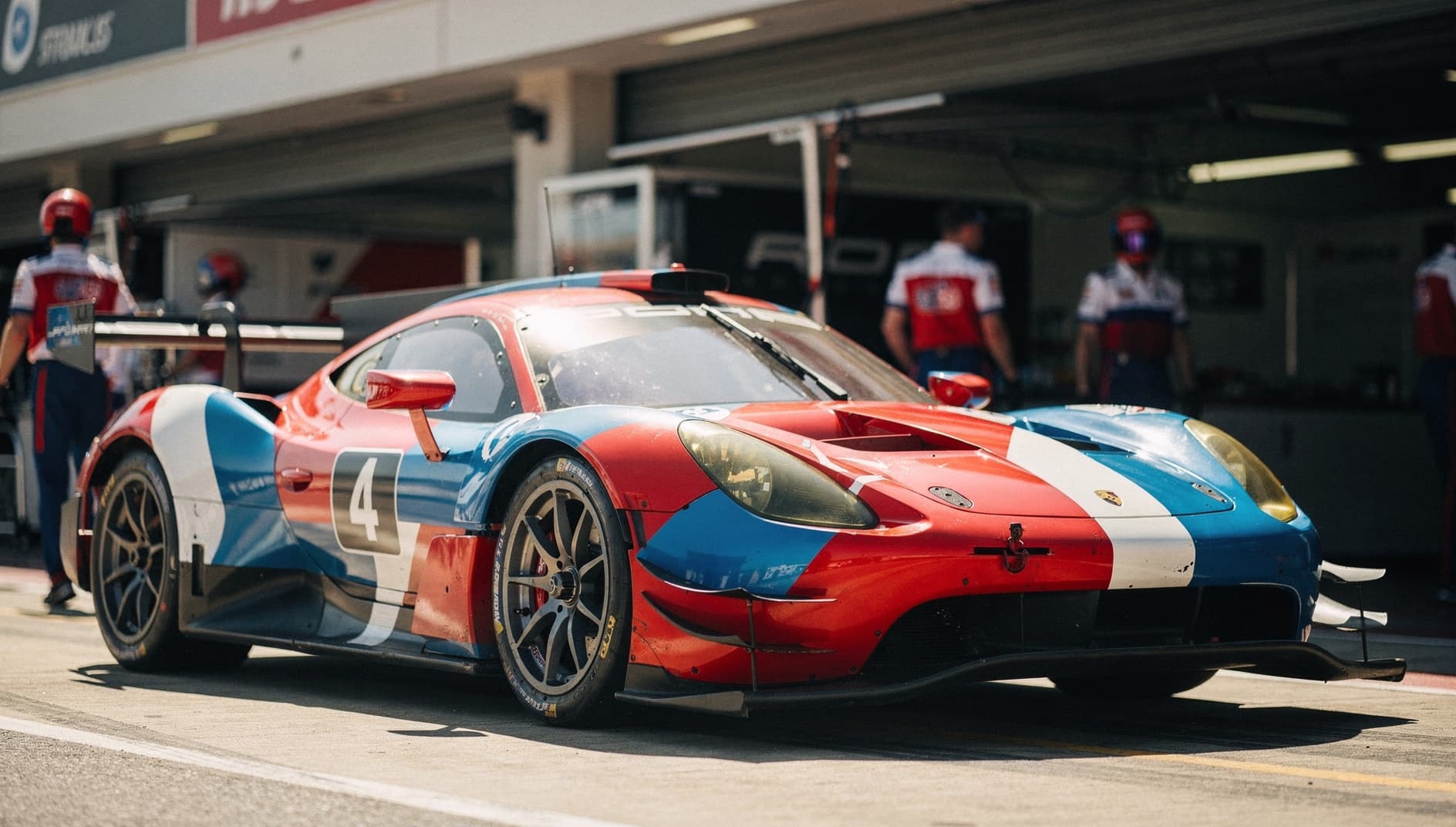
A race car livery has to do three jobs at once — pay the sponsors, satisfy the series rules, and read as a single identifiable car at speed and on screen. Surface is built for the layered, panel-based workflow race teams actually use.
Why this format
The car is
the deliverable.
In professional motorsports, the livery is the product. NASCAR Cup, NASCAR Xfinity, IndyCar, IMSA, IndyNXT, GT3, and the major touring series all run cars whose primary commercial purpose is to be seen with sponsor branding on them. The livery is the asset the sponsor pays for.
Each series publishes its own technical and decal regulations — number panel size and location, manufacturer mark placement, contingency-sticker zones, series logo positions. Designing outside those rules means the car gets bounced at tech inspection. Designing on top of them is the job.
Race teams also work on faster cycles than most fleets. Sponsors come and go between races, paint schemes change for marquee events, and a primary sponsor often runs different schemes for different tracks. The design tool has to support partial re-prints without redrawing the whole car.
Design considerations
What a livery has
to get right
Sponsor hierarchy
Primary, associate, contingency. The primary owns the hood and rear quarter panels — the highest-value real estate in any livery. Associates take the doors, sail panels, and B-pillars. Contingency stickers (parts and series sponsors) live in the regulated locations the sanctioning body assigns.
Broadcast and at-speed legibility
A livery has to read on a TV broadcast at distance, on a phone screen, and from the grandstand at 200 mph. Sponsor logos sized for a static photograph will disappear on broadcast — the rule of thumb is to oversize the primary mark and let the secondary marks scale down only as far as the camera can hold them.
Number-panel rules
Each series has its own number panel size, location, and color contrast rules — NASCAR, IndyCar, and IMSA all publish series-specific guidance. Treat the number panel as a fixed canvas inside the livery, not as something the design works around at the end.
Partial wraps for race-to-race swaps
Sponsors come in and out across a season, and primary sponsors often run different schemes for different races. The livery has to be designed in layers so a hood, door, or rear-quarter panel can be reprinted and reinstalled between races without redoing the whole car.
Livery as identity
The best liveries are recognizable from a single corner panel. That comes from a strong color block, a distinctive shape, or a typographic mark — not from a busy collage of sponsor logos. Decide the identity move first, then place the sponsors inside it.
Each series publishes its own current rule book. Always check the technical and decal rules for the current season before sending to print.
The workflow
Built for the race-week cycle
01
Pick the chassis
Surface ships templates for stock car bodies, open-wheel chassis, and GT/sports car platforms. Pick the chassis that matches the entry — the panel breaks, sail-panel geometry, and number-panel zones are mapped.
02
Set the series-required layer
Number panels, contingency-sticker zones, manufacturer marks, and any series-required copy go in first at the size and location the sanctioning body specifies. Lock the layer.
03
Lay in the identity
Color blocks, livery shapes, typographic marks. Walk the camera around the 3D car to confirm the identity reads from any angle — front, broadcast three-quarter, rear, overhead.
04
Place sponsors by tier
Primary on the hood and rear quarter. Associates on doors, sail panels, B-pillars. Surface holds the sponsor placement zones as named layers so future swaps reuse the geometry.
05
Export by panel
Surface splits the design into panel-ready files with bleed and overlap baked in. For mid-season swaps, re-export only the panels that changed.
Templates
Templates for the
chassis you race.
Stock car, open-wheel, and GT chassis templates with panel breaks and number-panel zones mapped. Trailer templates for the hauler that follows the car to every race.
FAQ
Common questions
How are sponsors prioritized on a race car wrap?
What materials work for race conditions?
Do race series have wrap regulations?
Can wraps be quickly swapped between races?
What does a race livery wrap cost?
Design your livery
in Surface.
Free trial. No credit card. Print-ready files for every panel.
Keep reading
Related work
Solution
Surface for wrap shops
Production-floor view: panel-aware export, photo-real previews, and a workflow that fits the install team.
Open
Use case
Limo & livery
A different kind of livery — same word, different rules. Transportation services and the design language that fits.
Open
Blog
Field notes from the wrap floor
Sponsor placement, broadcast color, and the layout patterns that hold up at speed.
Coming soon