Workflow
·For Brand teams
Vehicle Wrap Install Timeline: What to Actually Expect, Day by Day
A buyer-side week-by-week timeline for vehicle wrap installs — what each phase covers, what slows it down, and what to do upstream to hit your launch date.
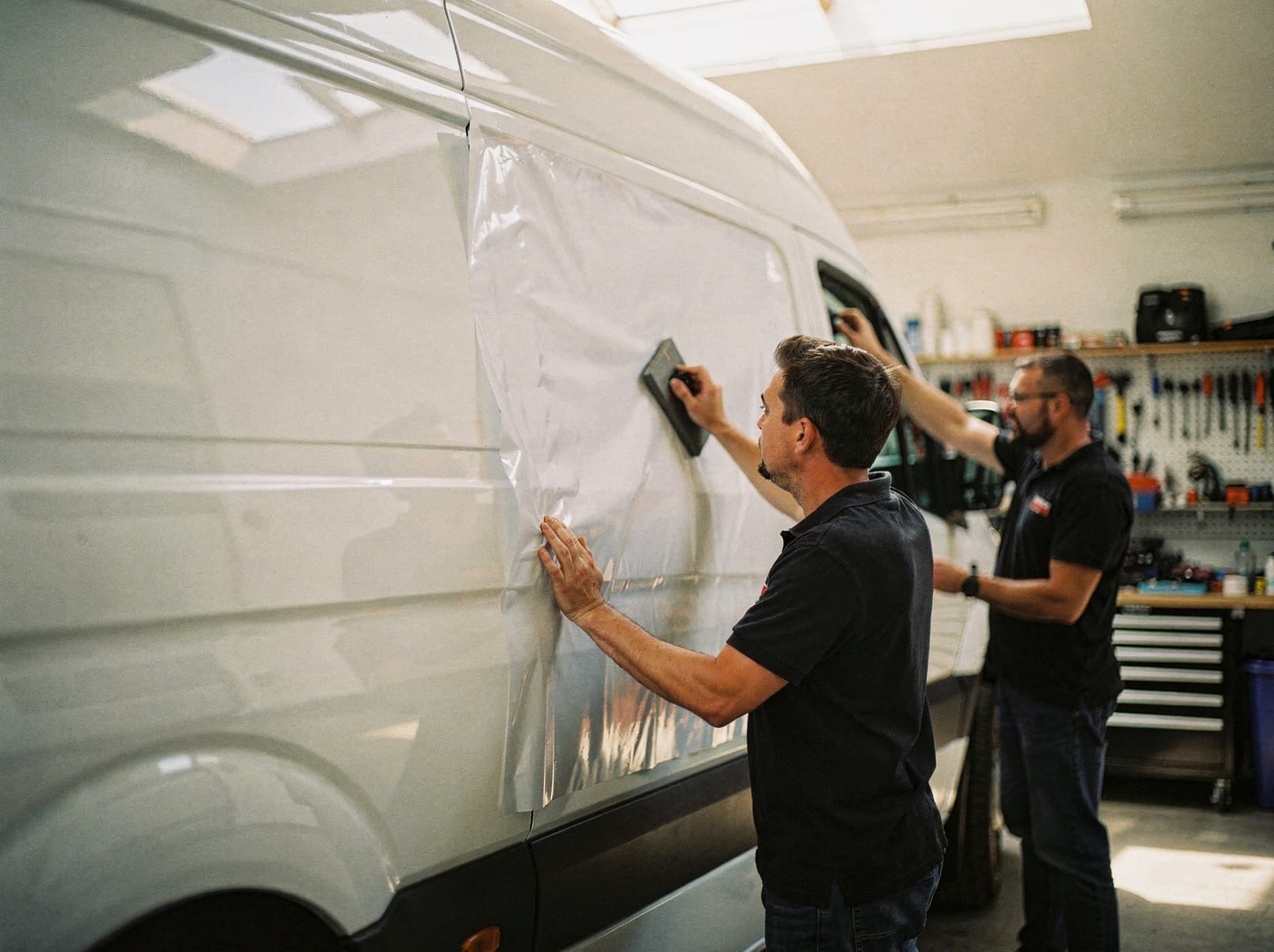
The marketing director asks "when will the van be wrapped?" and the wrap shop says "give us a couple of weeks." That answer is true at the average and useless for planning. A real install timeline depends on design approval, file quality, scheduling, and weather — any one of which can push the launch date a week or more.
This is a buyer-side reference for in-house brand teams committing to a launch date. It walks through the phases from PO to keys-back, what slows each phase, and what you can do upstream to keep the timeline tight.
Key takeaways
- 01A typical single-vehicle wrap project runs 2 to 4 weeks from PO to driving the wrapped vehicle, broken roughly into design approval (1 to 3 days), printing and lamination (2 to 5 days), install (1 to 3 days per vehicle), and 24 to 48 hours of cure time.
- 02The two biggest schedule killers are revision cycles and file rejections. A clean brief and an approved-first-time file design can shave a week off the average timeline. A messy brief and three revision rounds can add two weeks.
- 03Install bay scheduling is a real constraint. Most wrap shops book installs 1 to 3 weeks out. Reserving a slot when you start the project — not when files are ready — is how you protect the launch date.
- 04Cure time is non-negotiable. Driving a fresh wrap in heavy rain, through a touchless car wash, or in highway conditions within 48 hours of install risks edge lifting that won't show up until weeks later. Build the cure window into the launch plan.
The phases at a glance
Every wrap project moves through the same five phases. The duration of each one depends on the project's complexity and how clean the upstream work is.
| Phase | Typical duration | Who owns it |
|---|---|---|
| Design and revisions | 1 to 3 days for approval after files are first delivered; full design phase is typically 1 to 3 weeks before that depending on project complexity | Designer (in-house, agency, or freelance) and brand team |
| Pre-press and file release | Same day to 1 day after design approval | Designer or print vendor's prepress operator |
| Print and lamination | 2 to 5 days | Print vendor or wrap shop's in-house production |
| Install | 1 to 3 days per vehicle | Wrap shop install crew |
| Cure | 24 to 48 hours before exposing the wrap to heavy weather, car washes, or highway speeds | Vehicle operator (you) |
The compressed minimum for a single vehicle with everything going right is around 7 to 10 days from approved design to driving the wrap. The realistic average is 2 to 4 weeks. Fleets and complex jobs run longer, mostly due to install bay scheduling rather than per-vehicle install time.
Phase 1: Design approval (1 to 3 days)
This phase starts when the designer delivers files for review and ends when the brand team signs off. The design work itself takes 1 to 3 weeks before this; the approval phase is where most timelines slip.
The pattern that wrecks timelines is the revision spiral: round one feedback, round two that contradicts round one, round three raising issues that should have been in the brief. Three substantive rounds adds a week to the average project.
What slows this phase down
- Unclear brief. A brief that doesn't specify brand, message hierarchy, regulatory text, install date, or vehicle make/model produces designs that miss on round one.
- Multiple sign-off layers. When the marketing manager, brand director, and CMO all need to approve, every round takes 2 to 3 business days to clear the chain.
- Photos in lieu of vehicle measurements. A phone photo of the van produces a design that looks fine in mockup and breaks during install when the actual body line is different.
- Scope creep. "Can we also add the second logo?" three days in resets the work. A locked scope agreed in the brief prevents this.
What speeds it up
A complete brief delivered on day one (the brief-a-wrap-designer guide covers what to include). A single decision-maker on the brand side with sign-off authority. Agreed feedback windows written into the contract.
Heads up
Vague feedback is the silent timeline killer. "Make it pop more" forces another round without direction. Specific feedback ("the headline needs to be 30% larger and the phone number moved to the rear quarter panel") gets resolved in one round, not three.
Phase 2: Pre-press and file release (same day to 1 day)
The production handoff. The designer or prepress operator runs the file through pre-flight, exports to the printer's preferred format, and releases. In a competent workflow this is same-day; without a structured pre-flight pass, it takes a day or two and reveals file issues that bounce back to the designer.
The most common reasons for file rejection: fonts not outlined, color mode wrong (RGB instead of CMYK), images at insufficient resolution, missing bleed, incorrect file format for the RIP. See the wrap shop panel-prep checklist for the full list. Material spec mismatches between the PO and the file also stall this phase. A Friday-afternoon rejection usually means the job doesn't start until Monday or Tuesday.
What speeds it up: a pre-flight pass run by the designer before files leave the design environment, an established designer-printer relationship, and files delivered with a clear release note specifying material and finish.
Phase 3: Print and lamination (2 to 5 days)
The print run itself is faster than most buyers expect — a full vehicle wrap can print in a few hours on a wide-format printer. The longer duration is driven by:
- Production queue time. Printers run jobs in order; your job's start depends on what's ahead.
- Lamination cure. Eco-solvent ink needs roughly 24 hours of off-gas before lamination.
- Sample print and color check. Best practice is to print one panel, color-check against the approved proof, and get sign-off before running the rest. Adds 24 hours but prevents catastrophic color drift.
- Material availability. Standard cast vinyl in 54" or 60" is in stock at any working shop. Specialty materials (textured films, color-shift vinyls) may need to be ordered.
What speeds this phase up: confirming material is in stock at PO time, not at print time; standardizing on a single material spec across fleet projects; scheduling the print run ahead of the install bay reservation, not the same day.
Phase 4: Install (1 to 3 days per vehicle)
Time per vehicle depends on complexity:
- Simple partial wrap (door logos, fleet number, contact info): 4 to 8 hours
- Half wrap (sides and rear or sides and hood): 1 to 2 days
- Full wrap (all body panels): 2 to 3 days
- Complex full wrap with extensive recovery curves: up to 4 days for premium-quality install
Install crews work indoors in a temperature-controlled bay (most cast films want 60 to 80°F surface temp). The vehicle has to arrive clean, with accessories off (mirrors, badges, sometimes door handles).
What slows install down: vehicle not clean (shop has to wash, adding 2 to 4 hours), undisclosed vehicle modifications (custom mirrors, accessory racks), install bay scheduling conflicts (most shops book 1 to 3 weeks out), weather (for partial-indoor installs), and discovery of body damage that affects adhesion.
What speeds it up: vehicle delivered the day before, install bay reserved at PO time, single-day install with a dedicated bay.
Phase 5: Cure time (24 to 48 hours)
After install, the wrap needs time for the adhesive to fully bond and trapped air pockets to release through the air-channel adhesive. Non-negotiable physics, not a shop courtesy.
During the cure window: no high-pressure car washes (pressure can lift edges), no automatic brushed washes (ever, but especially now), avoid heavy rain at highway speeds (water at 70 mph finds its way under uncured edges), avoid extreme temperature changes (a 70°F bay to a 95°F lot before full bond can shift the install).
For the first 24 to 48 hours, park indoors or under cover. After that, normal driving is fine. Full chemical-resistance cure takes about a week, but the "drive normally" mark is 48 hours.
Sample week-by-week timeline
For a single full-wrap project on a clean brief, here's what the realistic week-by-week looks like:
| Week | Phase | Activity |
|---|---|---|
| Week 1 | Project kickoff and design | Brief delivered, designer starts work, install bay reserved at the wrap shop for week 4 |
| Week 2 | Design completion | First files delivered for review, round-one feedback, refined files delivered |
| Week 3 | Approval and pre-press | Final approval signed, pre-flight pass run, files released to printer |
| Week 4 | Print, install, cure | Printing days 1 to 3, sample-print sign-off, install days 4 to 5, cure over the weekend |
| Week 5 | Vehicle in service | Wrapped vehicle on the road for normal use |
This is the realistic timeline for a clean project. The compressed version (everything goes right, no revisions, install bay open) lands at 2 to 3 weeks. The extended version (multiple revision rounds, file rejections, scheduling conflicts) lands at 5 to 7 weeks.
For fleet projects, scale the print and install phases by fleet size. Five vehicles wrapped in sequence is typically 2 to 3 weeks of install bay time alone, even after design and printing are done.
What to do upstream to protect the timeline
The biggest schedule protection is reserving the install bay early. Calling the shop the day your files are ready usually means waiting 2 to 4 weeks. Calling them when you start the design phase means the bay is reserved when files arrive.
Second: deliver a complete brief. Every revision round adds 2 to 5 days. A complete brief that locks scope, hierarchy, regulatory placement, and sign-off authority on day one prevents the spiral.
Third: pre-flight files before the printer sees them. File rejections bounce the work back, lose a day, then wait for the next print queue slot.
Heads up
Don't promise a launch date based on the wrap shop's optimistic estimate. When the wrap shop says "two weeks," that's the median outcome on a clean project with no surprises. The 90th percentile is closer to four weeks. Build the slack into the launch plan and you'll hit the date most of the time.
What slows fleet timelines specifically
Fleets compound the single-vehicle timeline in three ways. Install bay throughput — a single bay handles 1 to 2 vehicles per day, so a 20-vehicle fleet through one bay is 10 to 20 working days of install alone. Vehicle availability scheduling — a fleet in active service can't all be off the road at once, so install timing has to coordinate with the operational calendar. Brand consistency review across vehicles — each vehicle type (van, box truck, sedan) needs its own panel-layout review before printing.
For fleets over 10 vehicles, build the timeline at 6 to 12 weeks from PO to last vehicle driving. Smaller fleets (3 to 8 vehicles) usually run in 4 to 6 weeks if the bay takes two vehicles in parallel.
What the wrap shop can't tell you upfront
A few honest realities. Their schedule depends on what's ahead — "two weeks" assumes the queue stays as it is, and a big fleet job booking in front of yours can push your date. Material delivery is sometimes the constraint — premium specialty films may have multi-week lead times. Install crew availability matters — most shops have a small number of A-tier installers, and booking with them is worth a day of waiting. Seasonal factors matter — peak season (spring fleet refresh, late summer pre-holiday) means 4+ week lead times.
If the launch date is real, ask directly: which week are you booking installs for, what's the realistic date for my job, what would compress it. That answer is usually more honest than the website-quoted lead time.
If you’re a brand team planning a wrap launch and you want a workflow that doesn’t lose a week to file revisions and another week to install scheduling, Surface for in-house brand teams → is designed to export panel-ready files with material spec metadata so the print shop ingests clean files the first time. Pair it with the brief-a-wrap-designer guide to get the upstream work right before the design phase even starts.
Related on Surface
Try Surface for free
The design tool built for vehicles, billboards, and every surface in between.
Keep reading
More from the blog
Pricing
Delivery Van Wrap ROI: The Math by Route Type, City, and Fleet Size
An honest deep-dive on delivery van wrap ROI — how route type, city, and fleet size change the math, and how it stacks up against paid digital and OOH.
Read
Workflow
In-House vs. Agency Wrap Design: A $-and-Time Decision Matrix
A decision framework for brand teams choosing between in-house wrap design and outsourcing to an agency — the cost, speed, consistency, and scaling tradeoffs that actually matter.
Read
Workflow
Briefing a Wrap Designer: A Template That Gets It Right the First Time
A practical, copy-pasteable brief template for vehicle wrap projects — what brand managers and marketing teams should hand off to get the right wrap on the first round, not the third.
Read